A bit late, but I'm just not getting time to get updated at the moment. Ho Hum. Anyway, on the 22nd June, I had a chance to have a go at another mosaic.
I got the kit out, and with a polar align done by pointing a compass and roughly making the polar axis lie in the track of the needle (a deeply accurate method I don't think). I connected all together and checked the views. The moon was very low (about 14 degrees) and that introduced it's own set of problems (the moon looked like it was under fast flowing running water). Still... having got setup I thought I might as well capture some frames with the C80ED, QHY5v, and I used my 2x barlow to get in a bit closer.
I set out to capture a mosaic using the 12-10 bit companding mode... this produces more detail but at the expense of a much reduce dynamic range... I'm still undecided on the merits of this mode... as the normal 8bit mode I can drive at higher frame rates.
Anyway... this is a 25 pane mosaic, each pane is 250 of 1000 frames, stacked and wavelets in Registax 5.1, merged in ICE. There were some exposure variations that cause some serious problems using the usual manual merge process with iMerge thanks to the changing sky conditions as the sun set.

Click for full size.
I then put some tubes between the barlow and camera, refocused and had a play at higher magnification. A complete nuts idea given the altitude of the moon, but hey... I was there, the kit was there, the moon was there... so why not...
Anyway.. Each of these is 250 of 1000 frames. I used the ROI settings of the capture software to get a higher frame rate also.
Herschel

Sinus Iridium (Bay of Rainbows)

Clavius

Gassendi

And finally, one a little more recent, a shot of the moon, rising out of the trees

Sunday, 11 July 2010
The Moon from the 22nd June

Tuesday, 22 June 2010
A lunar update
I'm being a bit poor at getting this updated at the moment... I've been having some more fun with the moon recently..
I'll start with a couple of cloudy moon shots


On to the more details stuff... I've found a mode on the QHY5v that allows for a better bit depth, at the cost of some dynamic range.. to prevent overexposure this means ending up with a bit darker image...
Here's a couple of comparison shots..


I did another 25 Pane mosaic (I can't remember when... it was a little after mid may I think)... Captured using the Celestron 80ED, QHY5v guidecam, a red filter and a UV/IR filter. 250 frames of avi from 1000 per pane, processed in Registax 5, and merged in iMerge.

click for full size
Then last week, I had a couple more goes, although this time at a much earlier day in the cycle.
I had some issues actually being able to point the scope in the right direction, thanks to trees etc, and with the moon being very low, the seeing was pretty poor, nonetheless... This is a 9 pane mosaic, the image details are as before, shot on the 15th.

Then on the 16th I had another bash, this was a little earlier in the evening, and I had some helpers in the form of my sons. The eldest focused for me, and they both helped in the capture.
This is a 22 pane mosaic, details as before, but shot in the 12-10 bit mode of the camera, and using a 30mm extension tube between the camera and barlow for increased image scale. Processing this was a little trickier, as starting that much earlier in the evening, the lighting levels changed as the evening wore on... meaning that the later panes appeared darker.

And just to finish off, I grabbed a few sections. Each is 250 frames from 1000 frames.
Petavius to Funerius

Pitiscus

and Endymion

I've really been enjoying these mosaics, and just seeing precisely what I can managed to pull out of my little 80mm refractor.
Monday, 26 April 2010
Deep Sky - An Update
This is a bit shorter than the Moon update...
All these were shot with the Canon 450d attached to the C80ED, mounted on a guided HEQ5, guided with a QHY5v attached to the Konus Vista 80s with PHD.
After M3, I decided to attempt a project on M101, my aim to get over 12 hours of capture. I decided to use ISO400 as a balance between the exposure time, doubling that used for my Orion widefield, and doubling the ISO also, to make up for the change in focal ratio. This took place over three nights, the guiding worked flawlessly...
Night 1 31 subs of 10 minutes

Night 2 added - 55 subs of 10 minutes

and the final result, Night 3 added - 76 subs of 10 minutes

I had intended to go for even more time at the outset, but I think the problem I'm facing is not having enough focal length to get the image large enough on the sensor to pull the details out. Not quite sure what I'm going to do about that at the moment... I think I'll probably get my webcam modded for long exposure.
I thought after this, I'd got for some widefield and easier targets, which my current setup is far better suited to...
Mars and The Beehive (M44)

M67

I also decided to try an experiment on M3, this time adding in my Kenko 2x teleconverter

That brings the Deepsky up to date.
Lunar - An Update
I've done so much Lunar stuff over the past few weeks, I can't really remember much of the details, but I'll do my best... All the images, except the one with the plane in were shot with the Celestron 80ED
A single shot at 600mm as I was setting up for some deep sky

The Moon and Mercury in Volcanic Sunset

The Moon, Mercury and Venus in the Volcanic Sunset

The Moon and Venus

A few shots of the first few days of this cycle, all shot with the 450d, Kenko 2xTC and the C80ED on my redsnapper tripod
Day 2

Day 3
In blue

And a bit later

Day 4

Then I thought I'd got the Lunar X, but it's not quite in the right place... nearly there..

I also did a mosaic of the disk, using a pair of x2 barlows (for x4), 69 panes, 350 frames per pane at about 20 fps, stacked and wavelets in Registax and tweaked.

I had some and games with my 5x Barlow as well...
A 7 pane mosaic

And some Craters
Walter

Stofler

Archimedes

Vallis Alpes

Triesnecker

and a 2 pane mosaic of the Theopholis region

Another single shot in a clear blue sky, from the next day

Another mosaic, just a single x2 barlow for this one, so less panes 19 I think, 300 of 350 frames at 30 fps, stacked and wavelets in Registax and tweaked

And a few closeups with the x5 Barlow
Clavius in shadow

And the Straight Wall

A mosaic of the Mountains

Then another day... Another blue moon at 1200mm

The Moon and a plane

A final Mosaic with a 2x barlow, this one is 22 panes, 250 of 1000 frames at about 25 fps, stacked and wavelets in Registax and tweaked

And a couple more closeups with the 5x, 300 of 1500 frames
Copernicus

Clavius

Saturday, 13 March 2010
Shared observing and M3
I've not had time to write this up till now. But there we go...
Last weekend, we had four clear nights in a row, but my back has not been good and I didn't get the rig out for the first couple of nights as it's quite heavy. On the Saturday, a friend and his daughter joined me in the garden for a short visual session. I set up the C80ED on my redsnapper and got out the eyepieces... it's been a while since I did that. We also took out the 10x50 and 15x70's.
We just had a short tour of the more visually interesting targets. I used the 24mm Hyperion on the C80ED and kept it at that. We started with M45, the sisters looking as stunning as ever in the dark sky. I pointed out the obvious difference, and lets be honest M45 is a very obvious choice for this, between looking without optics and what even something like a pair of 10x50 binoculars reveals of the sheer number of stars up there.
From there onto M42 (before it got to low, and the wings of the nebula were clear in the eyepice. M44, another stunning display of stars, we also spent some time looking at the Mirfak association and the double cluster.
I should have taken notes, but I didn't and now of course I can't remember... There were more targets we looked at.
Sunday was also clear, and after watching the early evening ISS pass and failing to capture it spearing Orion, I should have known then what the evening foretold, but having been over a month since actually getting any imaging done, I decided I'd go for it and suffer the consequences.
I carted the rig out, and setup. Polar alignment was as simple as normal, as was balancing, I still can't believe I was put off this at one point, and after debating what target to go for... should I choose M101 or M3... I started the goto alignment. All was going well, until after slewing to the third star, and getting ready for the final tweaks, I caught the power cable to the mount and knocked it out. Ok, thought I, start again. So off I went... now though the slews were going in completely the wrong direction. I don't know why. After trying to sort that out, I gave up, powered down, reset everything and tried again.
This time, the goto alignment went as I expected, and I was locked onto my target of choice within 5 minutes. Then my next problem... I couldn't find a guide star. I couldn't work it out, this was just odd... I slewed back to a bright star and had a short hunt around... nothing, then it occurred to me, that the focus might be out. So I started tweaking, and finally up came a star on screen. I must have knocked the focuser at some point. I slewed back to my target, fired a test frame (30s at ISO1600) and my target was pretty much in the middle of the frame. I kicked off PHD, chose a star and started calibration. This went well and once calibrated, went to setup my timer remote. That's when the next problem hit.
As I was programming the timer, it started blinking and that was that. Now what I thought. I took the timer remote in, removed the battery, cleaned it, reseated it, put it back. Nothing... Tried again, it came back to life. Phew... I plugged it back into the camera, went to check it, press the light button and again, it started blinking... I repeated the process. After 3 minutes of fiddling, I still wasn't getting anywhere. I checked for spare batteries, none of course. I was thinking I was going to end up having to keep track of the exposures on a timer. But at that moment, it sprang back to life. I was able to setup the remote for my exposure sequence, plugged it in, pressed go, and went off to get on with the things I needed to do.
Whereas, I'm normally up and running in under 30 minutes, it had taken me 90 minutes to get going. Ho hum... talk about a way of cutting the session short.
Anyway, I stopped capturing data a couple of hours later, and after the initial problems, everything had worked exactly as I'd expected it to.
After stacking and processing, here's the result..
A Widefield M3
Canon 450d on C80ED. 59 x 2 minutes @ISO200, with 15 darks and 22 flats.
QHY5v on Konus Vista 80s guiding with PHD
Mounted on an HEQ5
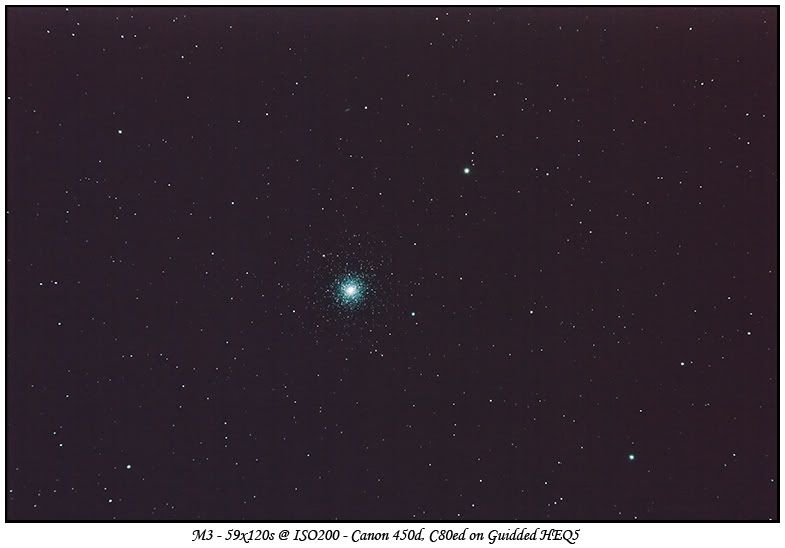
But there was something odd with this, I've had it before with M3, a green/cyan tint to the cluster. I don't know why. Anyway, with some additional tweaks in processing, I got
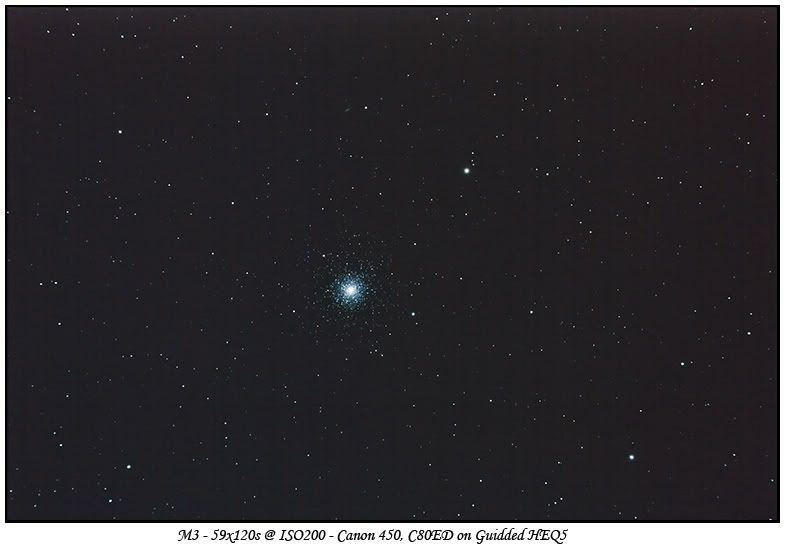
Which I'm much happier with. I've come to the conclusion, that ISO200 works great for subs of at least 5 minutes, but below that, such as with these 2 minute subs, I probably ought to be using ISO400. There was a little more noise than I was expecting showing up. Still it's all good information.

 Posts
Posts


