I've done so much Lunar stuff over the past few weeks, I can't really remember much of the details, but I'll do my best... All the images, except the one with the plane in were shot with the Celestron 80ED
A single shot at 600mm as I was setting up for some deep sky

The Moon and Mercury in Volcanic Sunset

The Moon, Mercury and Venus in the Volcanic Sunset

The Moon and Venus

A few shots of the first few days of this cycle, all shot with the 450d, Kenko 2xTC and the C80ED on my redsnapper tripod
Day 2

Day 3
In blue

And a bit later

Day 4

Then I thought I'd got the Lunar X, but it's not quite in the right place... nearly there..

I also did a mosaic of the disk, using a pair of x2 barlows (for x4), 69 panes, 350 frames per pane at about 20 fps, stacked and wavelets in Registax and tweaked.

I had some and games with my 5x Barlow as well...
A 7 pane mosaic

And some Craters
Walter

Stofler

Archimedes

Vallis Alpes

Triesnecker

and a 2 pane mosaic of the Theopholis region

Another single shot in a clear blue sky, from the next day

Another mosaic, just a single x2 barlow for this one, so less panes 19 I think, 300 of 350 frames at 30 fps, stacked and wavelets in Registax and tweaked

And a few closeups with the x5 Barlow
Clavius in shadow

And the Straight Wall

A mosaic of the Mountains

Then another day... Another blue moon at 1200mm

The Moon and a plane

A final Mosaic with a 2x barlow, this one is 22 panes, 250 of 1000 frames at about 25 fps, stacked and wavelets in Registax and tweaked

And a couple more closeups with the 5x, 300 of 1500 frames
Copernicus

Clavius

Monday, 26 April 2010
Lunar - An Update

Saturday, 13 March 2010
Shared observing and M3
I've not had time to write this up till now. But there we go...
Last weekend, we had four clear nights in a row, but my back has not been good and I didn't get the rig out for the first couple of nights as it's quite heavy. On the Saturday, a friend and his daughter joined me in the garden for a short visual session. I set up the C80ED on my redsnapper and got out the eyepieces... it's been a while since I did that. We also took out the 10x50 and 15x70's.
We just had a short tour of the more visually interesting targets. I used the 24mm Hyperion on the C80ED and kept it at that. We started with M45, the sisters looking as stunning as ever in the dark sky. I pointed out the obvious difference, and lets be honest M45 is a very obvious choice for this, between looking without optics and what even something like a pair of 10x50 binoculars reveals of the sheer number of stars up there.
From there onto M42 (before it got to low, and the wings of the nebula were clear in the eyepice. M44, another stunning display of stars, we also spent some time looking at the Mirfak association and the double cluster.
I should have taken notes, but I didn't and now of course I can't remember... There were more targets we looked at.
Sunday was also clear, and after watching the early evening ISS pass and failing to capture it spearing Orion, I should have known then what the evening foretold, but having been over a month since actually getting any imaging done, I decided I'd go for it and suffer the consequences.
I carted the rig out, and setup. Polar alignment was as simple as normal, as was balancing, I still can't believe I was put off this at one point, and after debating what target to go for... should I choose M101 or M3... I started the goto alignment. All was going well, until after slewing to the third star, and getting ready for the final tweaks, I caught the power cable to the mount and knocked it out. Ok, thought I, start again. So off I went... now though the slews were going in completely the wrong direction. I don't know why. After trying to sort that out, I gave up, powered down, reset everything and tried again.
This time, the goto alignment went as I expected, and I was locked onto my target of choice within 5 minutes. Then my next problem... I couldn't find a guide star. I couldn't work it out, this was just odd... I slewed back to a bright star and had a short hunt around... nothing, then it occurred to me, that the focus might be out. So I started tweaking, and finally up came a star on screen. I must have knocked the focuser at some point. I slewed back to my target, fired a test frame (30s at ISO1600) and my target was pretty much in the middle of the frame. I kicked off PHD, chose a star and started calibration. This went well and once calibrated, went to setup my timer remote. That's when the next problem hit.
As I was programming the timer, it started blinking and that was that. Now what I thought. I took the timer remote in, removed the battery, cleaned it, reseated it, put it back. Nothing... Tried again, it came back to life. Phew... I plugged it back into the camera, went to check it, press the light button and again, it started blinking... I repeated the process. After 3 minutes of fiddling, I still wasn't getting anywhere. I checked for spare batteries, none of course. I was thinking I was going to end up having to keep track of the exposures on a timer. But at that moment, it sprang back to life. I was able to setup the remote for my exposure sequence, plugged it in, pressed go, and went off to get on with the things I needed to do.
Whereas, I'm normally up and running in under 30 minutes, it had taken me 90 minutes to get going. Ho hum... talk about a way of cutting the session short.
Anyway, I stopped capturing data a couple of hours later, and after the initial problems, everything had worked exactly as I'd expected it to.
After stacking and processing, here's the result..
A Widefield M3
Canon 450d on C80ED. 59 x 2 minutes @ISO200, with 15 darks and 22 flats.
QHY5v on Konus Vista 80s guiding with PHD
Mounted on an HEQ5
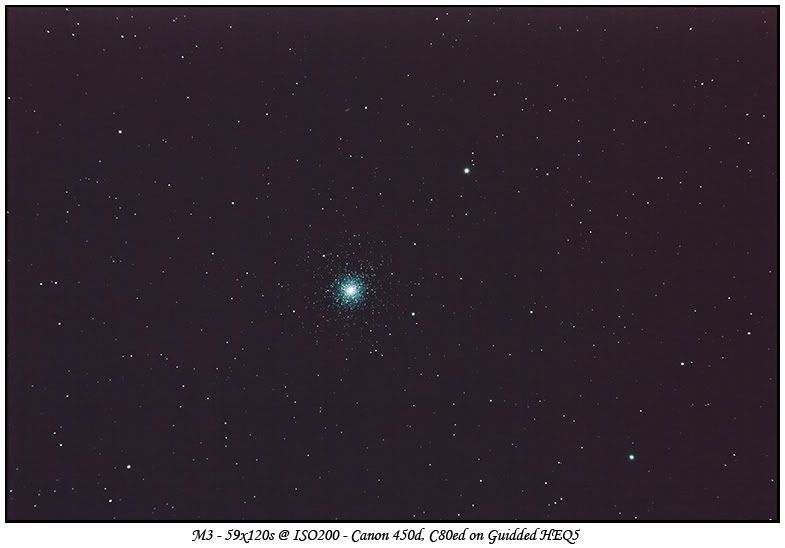
But there was something odd with this, I've had it before with M3, a green/cyan tint to the cluster. I don't know why. Anyway, with some additional tweaks in processing, I got
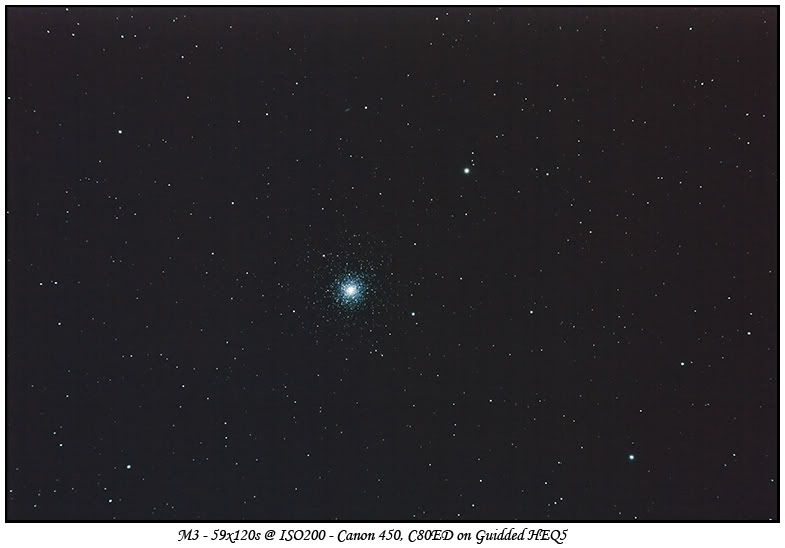
Which I'm much happier with. I've come to the conclusion, that ISO200 works great for subs of at least 5 minutes, but below that, such as with these 2 minute subs, I probably ought to be using ISO400. There was a little more noise than I was expecting showing up. Still it's all good information.
Saturday, 30 January 2010
Mars and the Moon, Mars and some Moon pieces.
A wonderful sight early on last night, with the full Moon and Mars lying near each other, low in the sky, against the deep blue of dusk. I got a couple of shots.
A shot of the full moon rising

And a little later the Moon and Mars

Very tricky exposure conditions, I really like the sky colour that's come through.
I also had a go at Mars last night. I've gotta say it's far harder than anything else I've tried so far. I guess cos Mars is so small..
Anyway, 1000 of 2000 frames, stacked in registax. I don't know why I've got an odd halo around it, I'm suspecting something to do with the little Mak, but I'm very pleased with this for my first attempt, it's got surface detail

I also had a quick play about on a couple of lunar features, again not easy with the full moon, with the 5x barlow (even harder)... each of these is about 500 of a 1000 frames.
Aristarchus

Reiner Gamma

And I think this one is Pythagoras
I have no intention of ever trying to do a full mosaic at this image scale, apart from being there all night, I do not have enough hard disk space to store all the AVI's...
Anyway, I used the Skymax 102 and played with different combinations of barlows... The best appears to have been a pair of 2x stacked. Focussing was really very hard.
Thursday, 28 January 2010
Playing on the moon
Twas a clear night, but with a high mist. The mist did interfere a little, but it sure helped with the seeing... I got out for some imaging... But first, a single shot with the 450d 2xTC, the C80ED on a camera tripod.

A little later, all done, I got the kit out... The Skymax 102 with the QHY5v on the HEQ5. Using a gamepad via EQMOD to control it all (that makes life so much easier). I setup with the 2x barlow to capture a mosaic of the disk. Here's a couple of frames from the total..
Clavius

Copernicus

The full mosaic. 93 panes of 350 frames in each AVI, processed in Registax 5, merged in Imerge and tweaked in GIMP.

Click for the full size version.
I then setup with the 5x barlow for a little play, the intent being to try and image Mars. It's really hard to use, and focusing is a total mare... anyway...
Gassendi

My attempts at Mars then failed completely... I couldn't find Mars, I spend some 20 minutes trying too. It wasn't that I couldn't see Mars, I could, but the very narrow FOV was just too small, then I ran out of power, and I and all my equipment needed to defrost. So it wasn't to be. Hopefully there'll be another clear night over the next week and I can have another bash at Mars.
Monday, 25 January 2010
Competitions
I entered some images in Galilean nights competition last year and one of them was shortlisted....

I've also pushed some images into the pool for this years Astro Photo Competition(although I've not entered yet, I'll hold off on that in case we might have a clear night over the coming months) and 2 of those have been put up on the front page as favourites

and

Friday, 22 January 2010
A clear night
On Sunday I had a clear night that didn't have a full or nearly full moon riding high in the sky, rather a new crescent moon, and I got a couple of shots of it.
A crescent showing Earthshine, I managed to get a star in this one too, although it's quite hard to see (HP 106739, Mag 7). This was shot at 600mm with the 450d through the C80ED on my redsnapper. To be honest, I'm rather amazed the moon didn't turn into a smear, as it was quite a long exposure, but ...

And then, just the crescent at 1200mm with the 2xTC fitted too

Amazingly, the sky stayed clear of clouds, and some time later I was able to get the entire rig out. I decided to try something a little different and piggy backed the camera to the C80ED, using the Canon 50mm lens. Balance was a little tricky and I had to add the second counterweight, but once done, it worked. I'd previously made a small dew shield for the lens, but found, when firing some test shots that it was too long, so carried out some surgery on it with a pair of scissors so all's good there. Got everything lined up, set the guiding going, and the camera capturing. After 15 minutes, some odd things were going on... the mount was tracking, but the camera was stuck on a not quite blank screen... ah, I know what that is... that's the battery.. what flat already... quick change... then went to check on the guiding status. The laptop had gone into a suspend state. So I bought it back out of suspend mode, and used mains power instead. That solved that one. But PHD and EQMOD were both messed up. So start all over again.
This time all worked perfectly. And I went about capturing a sequence of 5 minute exposures.
I selected ISO200 to test out exactly what effect this would have, expecting to pick up less data. I was amazed to discover that this wasn't the case. And in fact, it's probably my best result to date.
Anyway... the image..
ISO200, 33 x 5 Minutes @ 50mm, f/3.5
Mounted on the HEQ5, guided with PHD and the QHY5v on the Vista 80s
The camera has not been modified for Ha sensitivity

Click for bigger.
I enjoyed that, and I want to have a go at Auriga next.
Thursday, 14 January 2010
Reworking M45
I've never been happy with the M45 image I got last year.... It always struck me that something was missing... I had another bash last night...
I discarded the first night subs (about 12) as the alignment was totally different and was causing some difficult to process lines. Stacked, and gently gently tweaked, pushed and pulled, and after some time... ended up with ...
I'm much happier with this, although I think I might have overcooked things a little...

Click for a bigger version
Monday, 4 January 2010
More Moons
A few moon shots from over Christmas and New Year.
From the 27th, C80ED, 2xTC and 450d on the red snapper.

and pulling out the colour

Then on New Years day, it was clear, but very very cold, I setup for a mosaic. I decided to try a full disk mosaic using the Skymax and x2 Barlow. I set for 750 frames per avi, and started capturing. After capturing the first 45 panes I realised that I was going to run out of disk space before completing (50Gb wasn't enough)... so swapped to 500 frames per avi, and started trying to process the 750 frame avi's to clear some space.
There were a few occasions throughout the evening I thought I was going to run out of sky as clouds scudded through my FOV. And I used that time to process more of the data. Anyway, I continued, only to find, later on, that I'd shot the same strip of the moon twice. I'd not realised, and it didn't show in any of the avi's but there was a little drift in the mount, that could only be seen if left alone for 10 minutes. Yet more time and space wasted (I didn't realise till I was stacking all the frames).
Then, to finish things off, prior to me completing, clouds and snow came in. There wasn't much snow, and I don't think it fell for long, but I wasn't going to risk it. So I packed up.
After finishing the processing of 102 frames, and mosaicing, I got this

I'm pleased with how most of it turned out, just a shame about the small hole, and the remainder of the surface...
I then thought I'd put the 102 frames through MS ICE to see what would happen, and how it would come out. Here's the result, interestingly, ICE has filled in my little hole.

Click either of the above for the full size versions.
I also did a little extra processing on a small mosaic of Copernicus

and a couple of other craters and one Mare...
Mare Crisium

Langrenus

Cleomedes

Petavius

I'm sure they would have been better, had I shot longer AVI's, but I'm happy with the results. I didn't get a chance to image Mars as I'd wanted, although I'm not sure what results I would have achieved, but that's for another day.
Monday, 21 December 2009
Some Younger Moon shots
A few shots of the younger moon taken in the cold and snow over the weekend
A bit earlier on, the sky had a pink tint as the sun was setting

and with a passer by

Then a couple from a little later on


I've not been brave enough to get the gear out, in spite of having some clear skies, as the snow and ice makes the garden hazardous without carrying expensive equipment...
Monday, 14 December 2009
The Moon, Geminds and an Older Moon
I managed to get a shot of the moon against the clear blue sky the other morning... Lovely sight it was too

Last night, apart from some clouds whipping through, I went looking for Geminids. In between the clouds. It was a truly breathtaking sky last night.
I sat out with my 10x50's and spent a little while hunting around with the bins, I'm finding it so much easier this year to find my targets. I can't remember the order, but ...
m31, m35, m36, m37, m38, m41, m42, m44, m45 to start with...
Collander 70, the Mirfak association, the cluster around Bellatrix (I'm sure it's another Collander though I can't recall). I think I also found the cluster at the heart of the rosette.
After being sat there for a while, I was amazed to find, that I could, with averted vision, see the little fish, and the smiley face in Auriga, seven of the sisters, and I'm sure I could also make out some of the Mirfak association without the bins. m45 appeared to glow in the sky.
Oh that the cloud had stayed away, and not kept whizzing through, and I almost could have preferred to have got out the rig, given my success (or lack thereof) with catching any Geminids.
But, I enjoyed it, the views were just stunning.
I managed to get 2 Geminids on chip, I'm going to recheck the others and see if I've caught any, but I doubt it.

and

as I had 90 shots... I made a star trails with them. The clouds has made an interesting effect

And then this morning, I spotted a 26 day old moon, hanging low in the wonderful colours of predawn


 Posts


